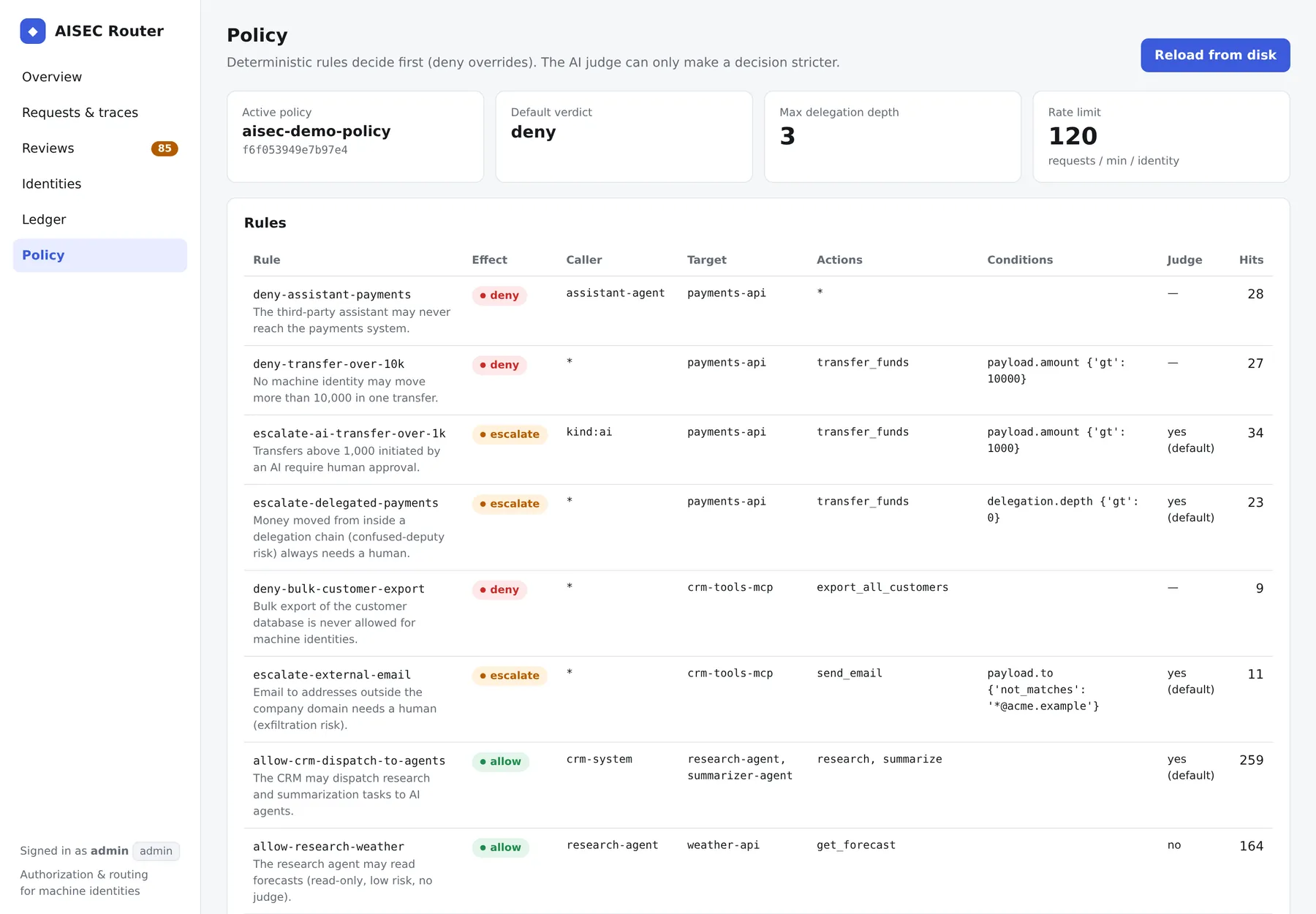
Deterministic rules run first. If a rule says no, the answer is no: the request is denied
and the judge is not even asked. A prompt injection that fools the model therefore can’t
unlock anything the policy forbids.
When the rules allow a request, the judge reviews it. Its verdict is combined with the
policy decision by taking the stricter of the two. If the judge is unavailable,
a fallback judge takes over.
The judge works from a policy written in plain language, with numbered sections such as SP1
for prompt injection and SP4 for scope creep in a delegation chain. Its reasons cite those
sections, so a reviewer can see exactly which concern was raised.
The judge runs on an open-weight safety model, so it can run on your own infrastructure.
Your request content doesn’t have to leave your environment to be judged.
The result: the AI judge adds protection on top of your rules but can never remove any.